
ANALYSIS AND SELECTION OF INDUSTRIAL PNEUMATIC CONVEYING TECHNOLOGIES
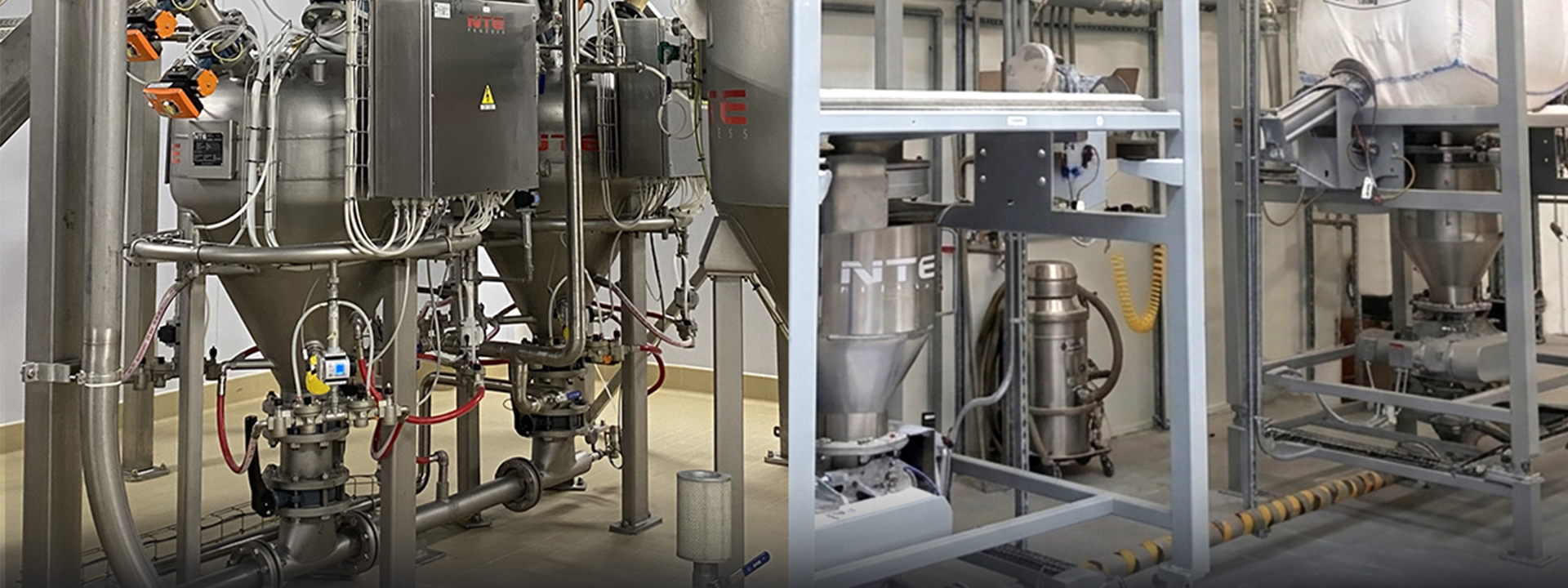
Choosing the right industrial pneumatic conveying technology is a strategic asset for companies aiming to maximize production efficiency. It is not merely about moving powders or granules; it is about optimizing operating costs and ensuring final product integrity through custom-engineered design.
In this article, we analyze the essential criteria for selecting the ideal system, comparing different conveying modes and the competitive advantages of this technology.
DILUTE PHASE VS. DENSE PHASE: CONVEYING MODES
The starting point for any plant is defining the handling method, which strictly depends on the air-to-material ratio.
- Dilute Phase Pneumatic Conveying: Characterized by high velocity and low pressure. It is ideal for non-abrasive materials and short-to-medium distances.
- Dense Phase Pneumatic Conveying: Utilizes low velocity and high pressure. This is the premium solution for fragile or highly abrasive materials, as it drastically reduces component wear and product degradation.
SYSTEM CONFIGURATION: VACUUM VS. PRESSURE
Beyond the phase, the propulsion method must be defined:
- Vacuum Systems (Negative Pressure): Ideal for extracting materials from multiple intake points toward a single collector. They are specifically recommended for hazardous, toxic, or explosive materials, as negative pressure prevents dust leakage into the environment.
- Positive Pressure Systems: Perfect for transporting materials from a single point to multiple destinations, even over long distances.
DESIGN AND LAYOUT: SYSTEM FLEXIBILITY
Unlike mechanical systems (such as conveyor belts or bucket elevators), powder conveying systems offer unparalleled design flexibility.
- Space Optimization: Piping can follow complex routes, overcoming height differences and tight bends.
- Easy-to-fit Integration: Seamless implementation into existing production lines without disrupting the factory layout.
- Modularity: The ability to expand the system based on future production requirements.
MAINTENANCE, RELIABILITY, AND HYGIENE
One of the primary advantages of pneumatic conveying systems is the reduction in maintenance costs. Compared to traditional systems, these plants:
- Reduce components subject to wear.
- Improve operational reliability.
- Require fewer maintenance interventions.
The enclosed and airtight nature of the piping makes these systems indispensable for applications requiring high hygienic standards, such as:
- Food Powder Conveying: Prevention of external contamination.
- Pharmaceutical Sector: Compliance with rigorous GMP regulations.
- Fine Chemicals: Safe handling of reagents and additives.
PROCESS QUALITY AND PRODUCT INTEGRITY
Preserving the physical characteristics of the material is a priority. If the material is fragile or prone to segregation, dense phase pneumatic conveying is the recommended choice. This technology allows for:
- Reduced transfer velocity.
- Limited particle breakage (degradation).
- Ensuring the powder blend remains homogeneous until it reaches its destination.
CONCLUSIONS: HOW TO CHOOSE THE IDEAL SYSTEM?
There is no “one-size-fits-all” solution in industrial powder handling. Proper engineering must be based on a technical analysis considering:
- Material Characteristics: Bulk density, particle size, abrasiveness, and hygroscopicity.
- Production Goals: Hourly flow rate and conveying distances.
- Safety: Compliance with ATEX regulations and dust containment.
Relying on experts in pneumatic system design ensures an efficient, safe system capable of generating long-term value.
Are you looking to optimize material handling in your company? Our engineers are at your disposal for a detailed analysis of your production needs. We design bespoke systems to guarantee maximum efficiency and energy savings.
📲 Contact us today for a personalized consultation
For more info
Contact us