
DENSE PHASE PNEUMATIC CONVEYING: PRESSURE VS VACUUM — MAKING THE RIGHT CHOICE
When it comes to moving powders, granules, or bulk materials within an industrial plant, the choice of pneumatic conveying technology is one of the most consequential engineering decisions in the entire plant design. Getting it wrong means unplanned downtime, premature pipe wear, product degradation, and runaway operating costs.
Dense phase pneumatic conveying is today the benchmark solution for the most “difficult” materials: fragile, abrasive, high bulk density products, or those prone to segregation. But within this category, two fundamentally different approaches exist — pressure systems and vacuum systems — each suited to distinct operational requirements.
In this article, NTE Process examines the technical characteristics of both technologies, the evaluation criteria, and the questions every production manager or process engineer should ask before making a decision.
What Is Dense Phase Pneumatic Conveying?
Dense phase pneumatic conveying differs from the more common dilute phase conveying in one key parameter: the air-to-product ratio. While in dilute phase the material is entrained by a high-velocity airstream (typically above 15–25 m/s), in dense phase the product travels at low velocity as compact plugs (slugs), pushed by a high-pressure gas in controlled volumes.
This principle delivers three structural advantages that make it superior for the most demanding applications:
- Reduced product degradation: low velocity dramatically cuts the mechanical impact between particles and pipe walls — critical for fragile products such as coffee beans, pharmaceutical tablets, pellets, and spray-dried materials.
- Lower component wear: pipes, bends, and valves last significantly longer, with a direct impact on maintenance costs and operational continuity.
- Segregation control: powder mixtures maintain their homogeneity throughout the entire conveying path — an essential requirement in food, glass, ceramics, and chemical industries.
Dense Phase Under Pressure: Operating Principle and Characteristics
How It Works
In positive pressure dense phase pneumatic conveying, the material is loaded into a closed vessel (the transporter or pressure pot) which is then pressurised with compressed air or an inert gas. The pressure differential between the vessel and the receiving end “pushes” the product along the pipeline at low velocity.
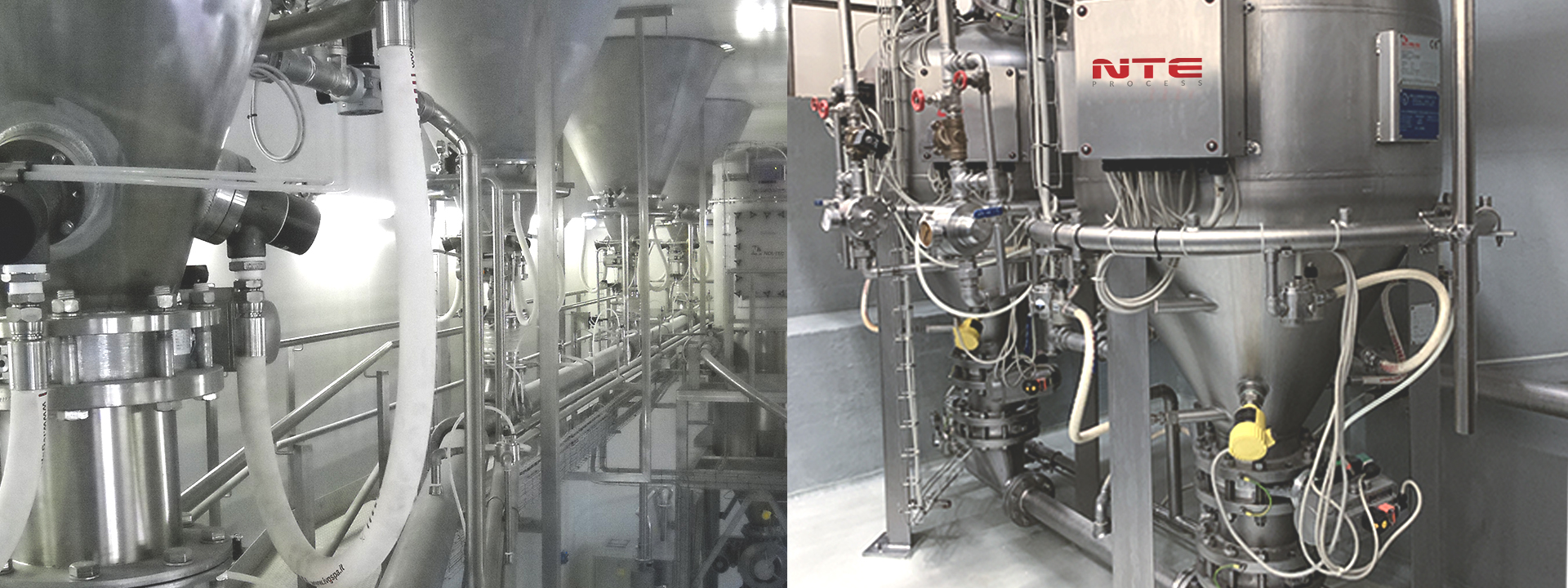
NTE Process implements this technology through Transporter M201 pressure vessels, available from 25 litres upward, certified to current regulations (PED, ASME, U-Stamp). The absence of rotating parts eliminates the risk of metal contamination and reduces maintenance costs.
Key Strengths
- Long conveying distances: positive pressure enables conveying over very long distances (tens or hundreds of metres) while maintaining dense phase conditions throughout the line.
- High bulk density materials: ideal for heavy products such as foundry sand, blast furnace slag, pozzolana, cement, and limestone.
- Single inlet, multiple outlets: positive pressure suits one-to-many configurations, using diverter valves or fluidodynamic splitters along the line.
- High throughput: through careful management of pressure and cycle times, significant hourly capacities can be achieved.
- Eco Dense-Tronic®: NTE Process has developed a patented solution to inject air at controlled pressure and volume at strategic points along the pipeline – through Air Assists®, creating compact product plugs at very low velocity. Eco Dense-Tronic®, powered by Artificial Intelligence, delivers efficiency gains of up to 40% and energy consumption reductions of up to 70% compared to conventional systems.
Critical Factors to Evaluate
- Available headroom below sources: pressure vessels require physical space below silos or hoppers; height-constrained environments can be a limiting factor.
- Inlet valve management: the loading valve must ensure precise filling times; incorrect sizing compromises hourly throughput and conveying stability.
- System pressurisation: the installation must be engineered to withstand operating pressures (typically 2 to 6 bar), with careful attention to sealing and leak management.
- Compressor sizing: instantaneous air consumption during the push phase is significant; adequately sized buffer tanks are required to avoid pressure fluctuations.
- Plugging risk: incorrect sizing of the pipeline diameter, operating pressure, or cycle timing can cause irremovable blockages and costly production stoppages.
Dense Phase Under Vacuum: Operating Principle and Characteristics
How It Works
In vacuum (negative pressure) dense phase pneumatic conveying, a vacuum unit downstream of the system — typically a vacuum pump or high-depression fan — generates a negative pressure that “draws” the material from one or multiple pick-up points toward the destination. The product also travels at low velocity with a high product-to-air ratio, but the driving force is suction rather than overpressure.
NTE Process offers this technology through systems such as the Nol-Vac M394 and vacuum conveying configurations combined with Air Assist® technology.
Key Strengths
- Multiple pick-up flexibility: vacuum systems excel when material must be collected from several points (multiple silos, filters, process machines) and delivered to a single destination. This makes them particularly valuable in complex production layouts.
- Compact installation footprint: since no pressurised vessel is required beneath each source, vacuum systems adapt better to environments with space or headroom constraints.
- Superior dust containment: negative pressure inside the pipeline ensures that in the event of a leak, ambient air enters the system rather than product escaping — powders do not disperse into the environment. This is a critical advantage for toxic, hazardous, or irritant products and in ATEX-classified zones.
- Suitable for abrasive, mixed, and fibrous materials: continuous low-velocity conveying preserves the particle size distribution and limits pipeline wear.
- Hygiene and containment: available in ATEX-rated configurations, with special finishes for food and pharmaceutical industries.
Critical Factors to Evaluate
- Distance limitations: available vacuum is physically bounded by atmospheric pressure (maximum approximately 1 bar absolute differential). This restricts vacuum applications to generally shorter conveying distances compared to positive pressure.
- Lower throughput capacity: at equivalent pipe diameter, vacuum systems typically handle lower hourly flow rates than pressure systems; achieving higher capacities requires larger pipe diameters or multiple parallel lines.
- Downstream filter/separator complexity: conveyed material must be separated from the air at the destination using a correctly sized filter or cyclone separator — a critical component requiring regular maintenance.
- Sensitivity to product moisture: hygroscopic products or those with elevated moisture content can cause wall adhesion or blockages, particularly in vacuum systems with complex routing.
- Air leak management: connection points and pick-up stations must maintain adequate sealing to sustain depression efficiency across the entire line.
Head-to-Head Comparison: Pressure vs Vacuum in Dense Phase
| Parameter | Dense Phase — Pressure | Dense Phase — Vacuum |
| Driving force | Overpressure (gas pushes product) | Negative pressure (system draws product) |
| Conveying distance | Long (up to hundreds of metres) | Medium-short (typically < 100–150 m) |
| Hourly throughput | High | Medium |
| Inlet/outlet configuration | One-to-many (single source, multiple destinations) | Many-to-one (multiple sources, single destination) |
| Installation space at source | Requires space below source (pressure vessel) | Minimal space required below source |
| Dust containment | Good | Excellent (negative pressure) |
| Hazardous/toxic materials | Usable with precautions | Preferred (dispersion risk minimised) |
| Fragile products | Excellent (low velocity + Air Assist®) | Excellent (low velocity + Air Assist®) |
| Abrasive products | Excellent | Excellent |
| Mixtures — segregation control | Excellent | Excellent |
| High bulk density | Very well suited | Suited for medium bulk densities |
| Energy consumption | Medium-high (high-pressure compressor) | Medium (vacuum pump) |
| ATEX applications | Yes | Yes (particularly well suited) |
Key Questions to Ask Before Choosing
The decision between a pressure and a vacuum system cannot be made in the abstract: it depends on a combination of technical, plant-related, and process-specific factors. Here are the critical questions every process engineer or procurement manager should work through with a specialist:
About the material:
- What is the bulk density and particle size distribution of the product?
- Is the product fragile, abrasive, hygroscopic, or prone to segregation?
- Is the product classified as hazardous, toxic, or explosive (ATEX dust)?
About the plant layout:
- What distance does the conveying line need to cover (horizontal and vertical)?
- Is there one or multiple pick-up points?
- Is there one or multiple destinations?
- What headroom is available below silos or source hoppers?
About production requirements:
- What hourly throughput is required?
- Does conveying need to be continuous or batch-mode?
- Are there specific hygienic requirements (GMP, food-grade, etc.)?
About the lifecycle of the installation:
- What compressed air infrastructure is already available on site?
- What are the acceptable maintenance cost levels?
- Will the system need to be expanded or modified in the future?
The Value of Expertise: The NTE Process Approach
There is no universal answer. Every dense phase pneumatic conveying installation is a unique engineering system that must be designed starting from empirical material tests and a thorough analysis of process requirements.
NTE Process, a global specialist in pneumatic conveying of powders and granules, supports its customers from initial material analysis through to plant commissioning, offering:
- Conveyability tests to characterise product behaviour in dense phase conditions.
- Custom-engineered system design tailored to the most appropriate technology (pressure, vacuum, or hybrid).
- Patented technologies including Air Assist® and Eco Dense-Tronic® to maximise efficiency and reduce energy consumption.
- Certified solutions for ATEX, pharmaceutical, and food-grade environments.
- After-sales support including scheduled maintenance, original spare parts, and remote assistance.
Conclusion
Choosing between pressure and vacuum dense phase pneumatic conveying is not a question of “which is better in absolute terms” — it is a question of which technology best fits your specific process, product, and plant layout. A pressure system is typically the right choice when distances are long, throughput requirements are high, and material is loaded from a single point. A vacuum system is preferred when collecting material from multiple sources in confined spaces, when dust containment is a priority, or when handling hazardous or toxic products.
In both cases, the quality of the engineering design and correct system sizing are just as decisive as the technology itself.
Ready to Find Out Which Solution Is Right for Your Process?
NTE Process’s specialist engineers are available for a free, no-obligation consultation. We analyse your material characteristics, plant layout, and production targets together — with data, not guesswork — to identify which dense phase pneumatic conveying technology delivers the best return on investment for your operation.
→ Contact us today and request your free technical consultation
Don’t wait for a degradation, plugging, or energy cost problem to slow down your production line: the right solution exists, and it starts with a conversation.
For more info
Contact us