
HOW TO SIZE A DENSE PHASE PNEUMATIC CONVEYING
Guide to Dense Phase Pneumatic Conveying: Operation and Sizing
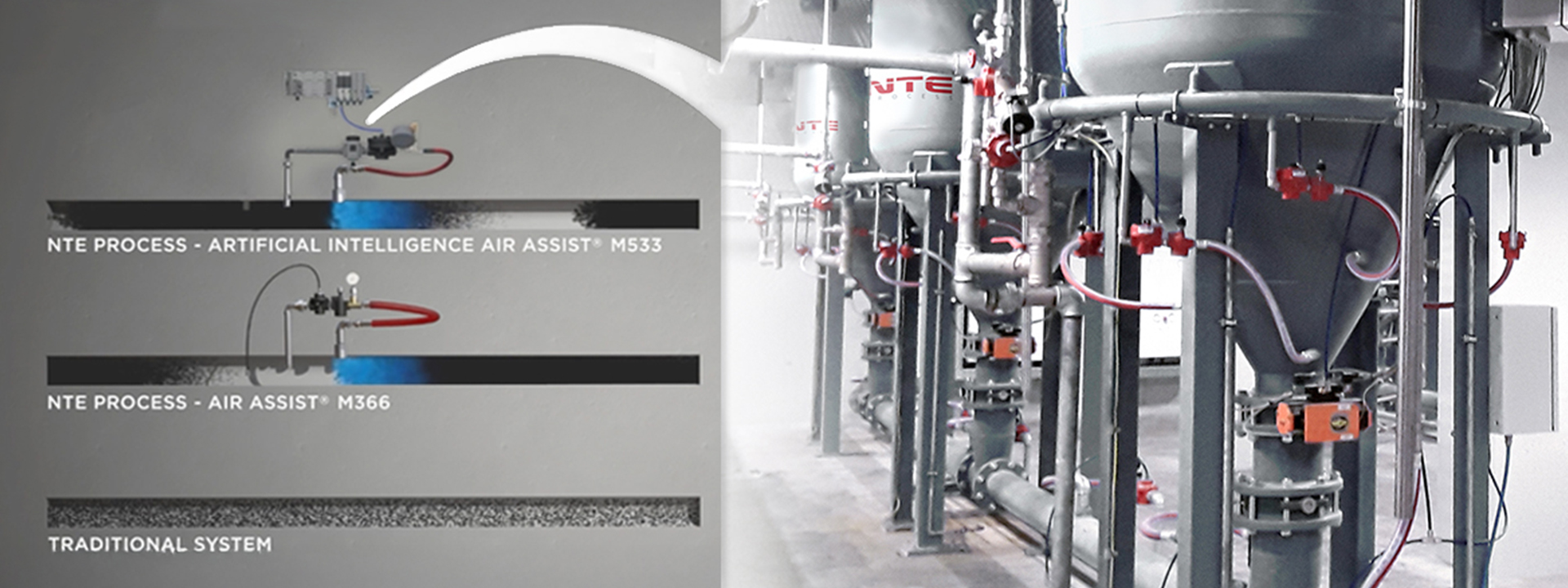
Dense phase pneumatic conveying represents an advanced engineering solution for the bulk handling of solids and powders through enclosed pipelines. This technology is specifically designed for “challenging” products: heavy materials (density > 1 t/m³), abrasive, friable, or blended batches.
How Does Dense Phase Work?
Unlike dilute phase systems, this method utilizes a low volume of gas at high pressure. The material moves at a controlled velocity in the form of “slugs,” drastically reducing the mechanical impact between particles and the pipe walls.
Key Advantages
- Product Integrity: Reduced segregation and degradation (ideal for fragile materials).
- System Longevity: Minimal component wear due to low-velocity transport.
- Economic Efficiency: Low operational costs and simplified maintenance.
- Versatility: Ideal for sand, cement, chemicals, graphene, lithium, and more.
Why Correct Sizing is Fundamental
Accurately sizing a system is not just about functionality; it is a matter of operational and economic sustainability. Incorrect sizing leads to:
- Energy Waste: Excessive compressed air usage unnecessarily increases utility costs.
- Plugging (Blockages): If pressure or pipe diameters are underestimated, material can block the line, causing expensive downtime.
- Premature Wear: If the velocity is too high, the “dense phase” advantage is lost, turning it into a semi-dilute phase that abrades components.
- Compromised Quality: Imprecise sizing can cause granule breakage (degradation) or the separation of mixtures (segregation).
Sizing Procedure: Step-by-Step
Project validation always begins with empirical material testing. Once experimental data is obtained, follow these essential steps:
- Volume and Cycle Analysis
- Calculate Hourly Volume: rate (t/h) ÷ density (t/m³) = m³/h.
- Select Cycles per Hour: This depends on the conveying distance. The longer the distance, the lower the number of allowable cycles to ensure transport stability.
- Transporter (Vessel) Selection
- Divide the hourly volume by the number of cycles to determine the required vessel capacity.
- Time Management and Instantaneous Flow Rates
- Cycle Time: Includes filling, pressurization, and discharge (conveying).
- Instantaneous Flow Rate: This is the required transfer speed during the active “push” phase to meet the total hourly quota.
- Line and Component Sizing
- Inlet Valve: Must ensure the vessel fills within the allocated time.
- Pipe Diameter: Based on the cross-sectional area. The instantaneous flow rate is proportional to the section area (A = π · r²).
- Air Consumption and Power Calculation
- Instantaneous air consumption is proportional to the pipe section.
- Calculate the consumption per cycle and multiply by cycles/hour to correctly size the compressor and accumulation tanks.
- Velocity Analysis
Determine the air velocity and the average material velocity to ensure they remain within dense phase limits (avoiding transition to dilute phase).
Conclusion
In conclusion, adopting dense phase pneumatic conveying is not merely a technical choice but a strategic investment to optimize industrial bulk handling processes. Correct sizing—grounded in rigorous empirical testing and precise engineering design—is the only way to guarantee the long-term operational and economic sustainability of the system.
Partnering with industry experts during this delicate phase allows you to maximize energy efficiency, extend equipment longevity, and, above all, preserve the quality and integrity of the handled product, providing a vital competitive edge in today’s industrial markets.
For more info
Contact us