
SPRAY DRYERS FOR THE CERAMIC INDUSTRY: TECHNOLOGY, ADVANTAGES, AND APPLICATIONS
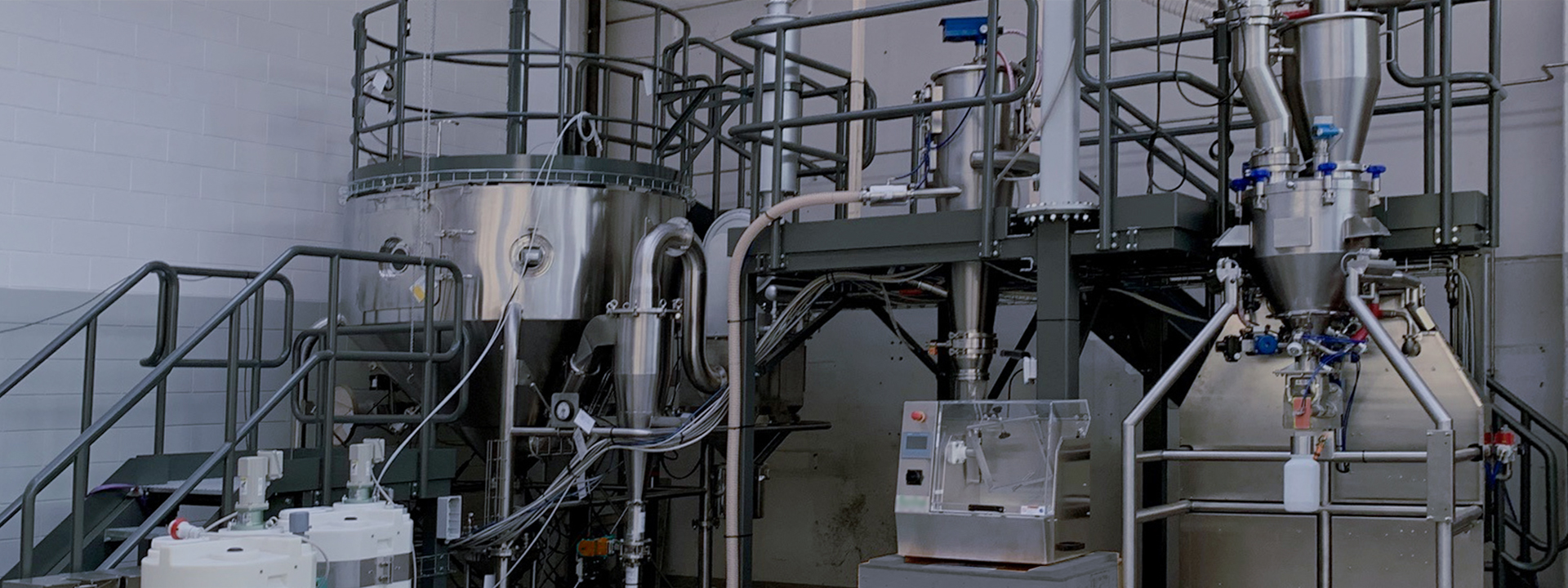
In the industrial production sector, raw material efficiency determines the quality of the final product. A spray dryer is the system that transforms a liquid solution or suspension containing ceramic material into homogeneous granules, ready for subsequent production stages. Today, this technology represents the global benchmark for the production of human prosthetics, watchmaking, and advanced technical ceramics, as well as floor tiles and porcelain stoneware.
What is Spray Drying?
Ceramic spray drying is an industrial technology used to transform slurry into powders with specific characteristics required for the final product. The process occurs through the atomization of the liquid into a hot air stream, which allows for rapid drying and the formation of solid particles. Thanks to its efficiency and repeatability, the industrial spray dryer is now a standard in the production of ceramic raw materials.
How Does a Spray Dryer Work in the Ceramic Process?
In the ceramic sector, the spray dryer is used to transform initial slurries into engineered powders suitable for further industrial processing. It is essential for the process to control the physical and morphological properties of the created powders, including:
- Uniform particle size distribution
- Residual moisture content
- Spherical particle shape
- Flowability
- Constant density
These characteristics make spray drying a fundamental technology for ensuring stability and quality in ceramic production processes.
Advantages of Industrial Spray Dryers for Ceramics
Adopting an industrial spray dryer means choosing technology that optimizes every phase of the ceramic production process, from powder quality to the reduction of operating costs.
✅Consistent Powder Quality: spray drying produces spherical, homogeneous granules, improving compaction and reducing defects.
⚡ High Production Efficiency: the process is continuous and highly automated, ideal for high-capacity ceramic plants.
♻️ Process Control: modern spray dryers allow for precise control of operating parameters, ensuring repeatability and product standardization.
🔧 Operational Flexibility: systems can be custom-designed for different types of productions, from standard tiles to advanced technical ceramics.
📉 Cost Optimization: reduced waste, energy efficiency, and seamless integration into industrial processes contribute to a lower total cost of production.
🖥️ Industry 4.0 Compatibility: new-generation atomizers integrate with IoT systems, real-time data analysis, and advanced automation for precise monitoring and predictive maintenance.
Applications of Spray Drying in Ceramics
Spray drying technology is widely used across various segments of the ceramic industry:
- Ceramic Tile Production: preparation of powders for dry pressing.
- Porcelain Stoneware: atomization of high-performance bodies.
- Technical Ceramics and Functional Oxides: production of advanced materials with controlled properties.
- Refractory Materials: optimization of particle size distribution.
- Specialty Powders: composites and innovative materials used in electronics, semiconductors, biomedical ceramics, and aerospace.
Why Choose a Latest-Generation Spray Dryer?
New-generation industrial spray dryers for ceramics integrate advanced technologies to guarantee:
- Increased energy efficiency
- Reduced emissions
- Automation and digital control
- Long-term operational reliability
Spray drying is a key technology for modern industrial production. By transforming slurry into high-quality atomized powders, spray dryers represent a strategic element for optimizing performance, efficiency, and process control.
FAQ
Is the spray dryer compatible with automation and Industry 4.0 systems?
Yes. Latest-generation atomizers are designed for integration with SCADA systems, advanced PLCs, and IoT platforms. Real-time monitoring of temperature, flow rate, pressure, and particle size allows for continuous process control, predictive maintenance management, and full production traceability.
Which ceramic raw materials can be processed with spray drying?
Spray dryers adapt to a wide range of ceramic formulations: clay and kaolin-based mixtures for tiles, functional oxides (ferrites, titanates), high-purity ceramics (alumina, zirconia, SiC), steatite, and glass powders. Adjusting process parameters allows for the optimization of results for each specific material type.
Looking for an Atomizer for Your Production Line?
Our technicians are available to analyze your needs and propose the spray drying solution best suited to your ceramic process: learn more about our spray drying solutions or contact us for a customized consultancy.
For more info
Contact us